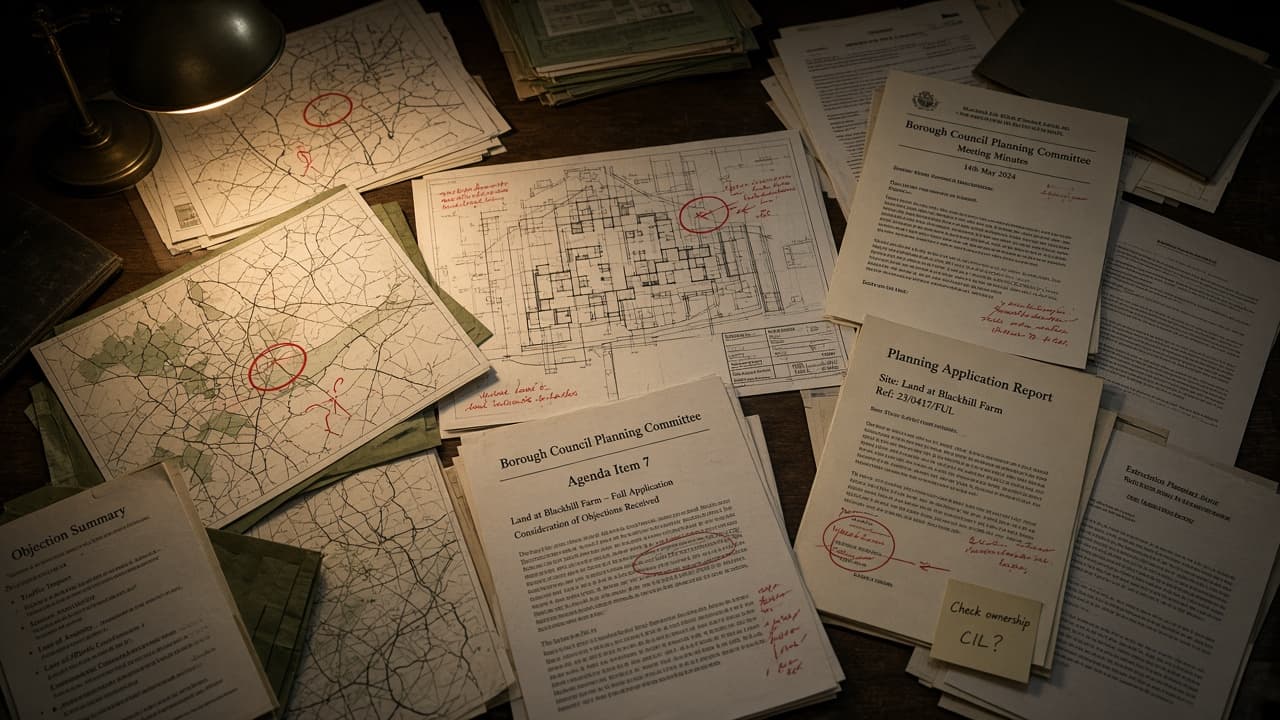
Six Years in Plain Sight
How regeneration plans are assembled in public, one governance layer at a time, and why the community only ever sees the last step.
On 1 July 2026, the staff at the Botanic Gardens aviary in Churchtown, Southport, were told the aviary was closing. The decision had been made five months earlier, in February, as part of the annual council budget.
From the community's perspective, this is where the story starts.
From the public record's perspective, the story starts in September 2020.
The advisory board as the first layer
The Southport Town Deal Board met for one of its earliest substantive sessions on 15 September 2020. Under “Green Spaces potential projects,” the minutes record: “‘Green ribbon’ (e.g. Botanic Gardens, Hesketh Park, etc).”
That is one line in one set of minutes. It is also the origin point of a transformation plan that six years later requires the closure of an 87-year-old community facility.
Advisory boards like the Town Deal Board are not elected. They do not publish their membership's declared interests in accessible registers. Their meetings are not open to the public. The guidance that established them requires transparency but does not enforce it. In Southport, the board that first proposed the Botanic Gardens transformation has members who hold undeclared equity worth tens of millions in the town's largest private employer, a company whose digital consultancy arm received a Town Deal contract after the board member pitched it from the same floor, and a property letting company on the street that the Town Deal is regenerating. None of this is in any register the community can access.
But the proposal itself is public. It is in the meeting minutes. The journey from that single line to an £80,750-a-year aviary being closed is documented in council papers published over six years. Most of it nobody assembled.
The professional services layer
Between September 2020 and February 2026, the following things happened.
Green Sefton's annual reports listed the aviary under “amending what we manage and how.” A pre-development grant of £79,625 was awarded by the Heritage Lottery Fund. A seven-month public consultation ran, gathering over 1,100 responses. A vision was adopted for new attractions and a £7.3 million transformation scheme. A Stage 1 Heritage Lottery bid was targeted for December 2025. In December 2025, a residential lodge inside the park was approved for disposal under the Cabinet Member's delegated authority, with proceeds directed to the general capital fund.
Every one of these decisions was taken through a legitimate governance process. Each committee paper was published. Each officer report was filed. Individually, none of them looks unusual. A Heritage Lottery pre-development grant. A public consultation. An asset disposal. These are routine instruments of council business.
Together, they are the architecture of a plan.
The budget decision as the final layer
The aviary closure appeared in the February 2026 budget as a single line item: close the aviary, save £60,000 a year. The consultation that shaped the transformation plan had been completed. The pre-development grant had funded the scoping. The lodge had been disposed of. The site was ready.
The community found out in July.
The welfare experts who backed the closure, SIBA discovered, had been contacted by the council after the decision was made. The BBC confirmed it. The decision was already taken before the justification was assembled. That reversal of sequence is not unusual in regeneration decisions. It is how the final layer gets publicly acceptable framing while the plan executes.
What the public record shows when treated as one corpus
The SIBA investigation used Institrace , a UK public records intelligence platform holding over 1.1 million documents from 1,322 public bodies, with the Sefton corpus running to over 20,000 documents.
Searching for “Green Ribbon” across the corpus returns six documents spread across five years. Together they trace the concept from its first appearance at the September 2020 Town Deal Board to its delivery in current Green Sefton annual reports. No single document tells the story. The corpus does.
Searching for “aviary” returns 82 documents. The earliest relevant one is from March 2025, when the Green Sefton annual report listed the aviary under items being “amended” in how the team manages its workload. Thirteen months before the public found out, the internal record shows the direction of travel clearly.
This is the pattern. The individual documents are public. They are not fragmented in bad faith. Committee systems produce papers on a meeting-by-meeting basis for a specific audience. Nobody assembles them into a single narrative for the community that is most affected. The intelligence required to connect them is not available by default.
What communities watching regeneration plans should ask
Every significant regeneration project in England will have a version of this journey. The advisory board meeting where the concept is first floated. The officer report that begins scoping it. The external consultant engagement that legitimises the vision. The consultation that captures community input without changing the fundamental direction. The budget decision that executes.
Each layer is visible. None of them, individually, reveals the destination to someone who is only watching one layer.
The questions worth asking, early and systematically, are these. What advisory bodies in this town have proposed what projects? Who sits on those bodies, and what have they not declared? What consultancies have been engaged to develop the plan? When assets are disposed of, where do the proceeds go?
These questions are answerable from public records. Committee minutes, Companies House filings, land registry searches, FOI requests to confirm what was consulted on and when. The records exist. They are not connected by default. Connecting them is the work.
The community that sees only the last step will always be surprised by decisions that were never secret. They were just spread across six years of papers nobody put in the same room.
SP-13: It Was Never About the Birds documents the full Botanic Gardens investigation, including the Town Deal Board governance findings, the lodge sale, and the two votes. Published 22 September 2026.
Author
Damian Roche
Founder, SIBA Digital
Ex-British Army, Queen's Guards. 20 years in web development and SEO. Built the SIBA investigation methodology from public documents alone. Cross-referencing Companies House filings, director networks, procurement chains, and FOI strategy. The same discipline is applied to every audit.